My name is Tom and The Chimney Experts INC is my company. Most of my work sits in Allegheny and Westmoreland County, so let me say this up front: I cover Washington County too, and Canonsburg is a regular stop. What I find here is usually not one broken thing. It is a chimney nobody has been up on in ten or fifteen years, and by the time I am on the roof there are three or four items that all trace back to the same cause, which is water getting in from the top. Call me and I will get up there and tell you what it actually needs.
☎ Call (412) 440-5871 Get a Free Estimate
A Canonsburg Chimney, Before and After
This one is a good example, because four things got done in one visit and every one of them was caused by the item before it.
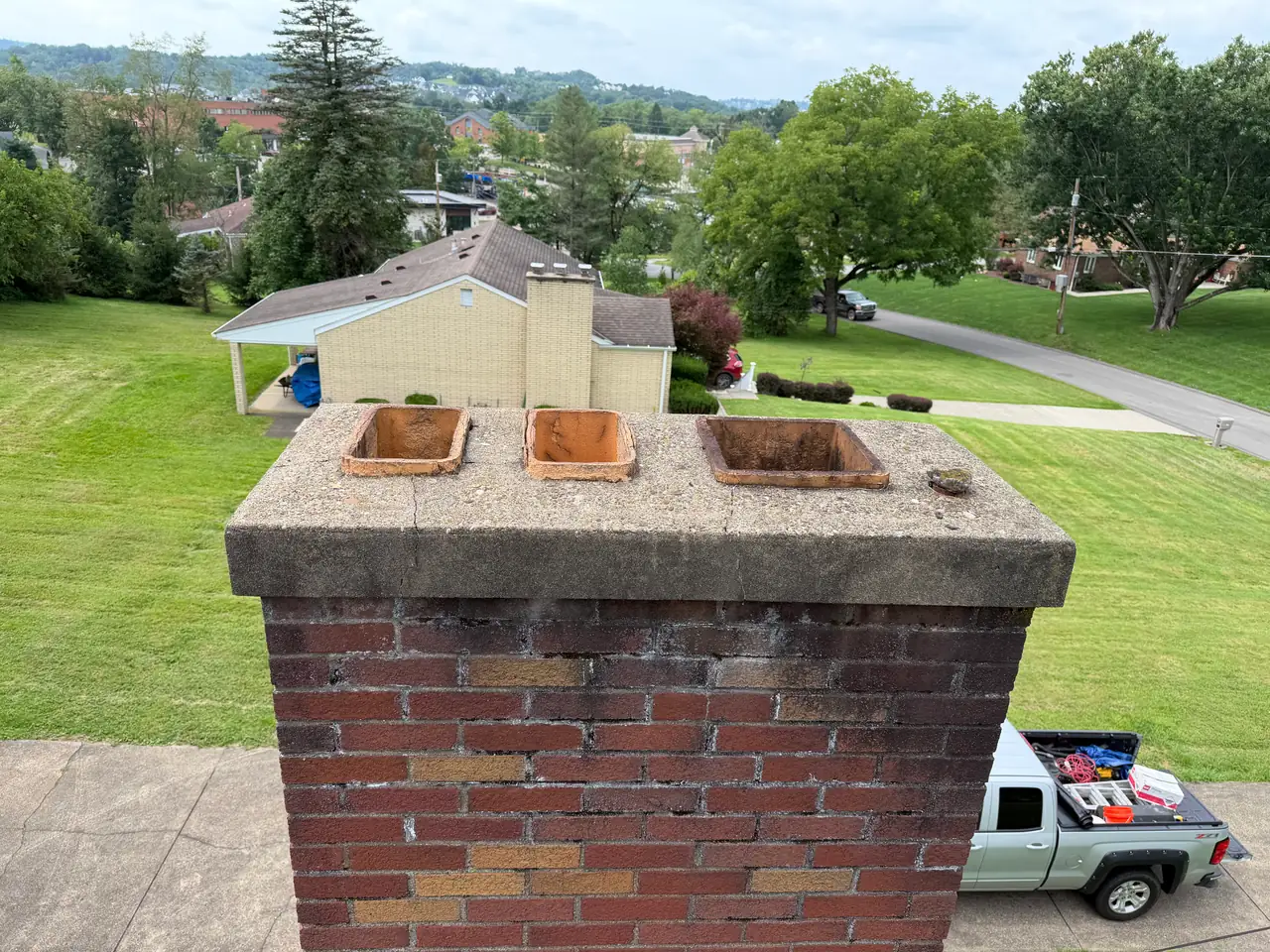
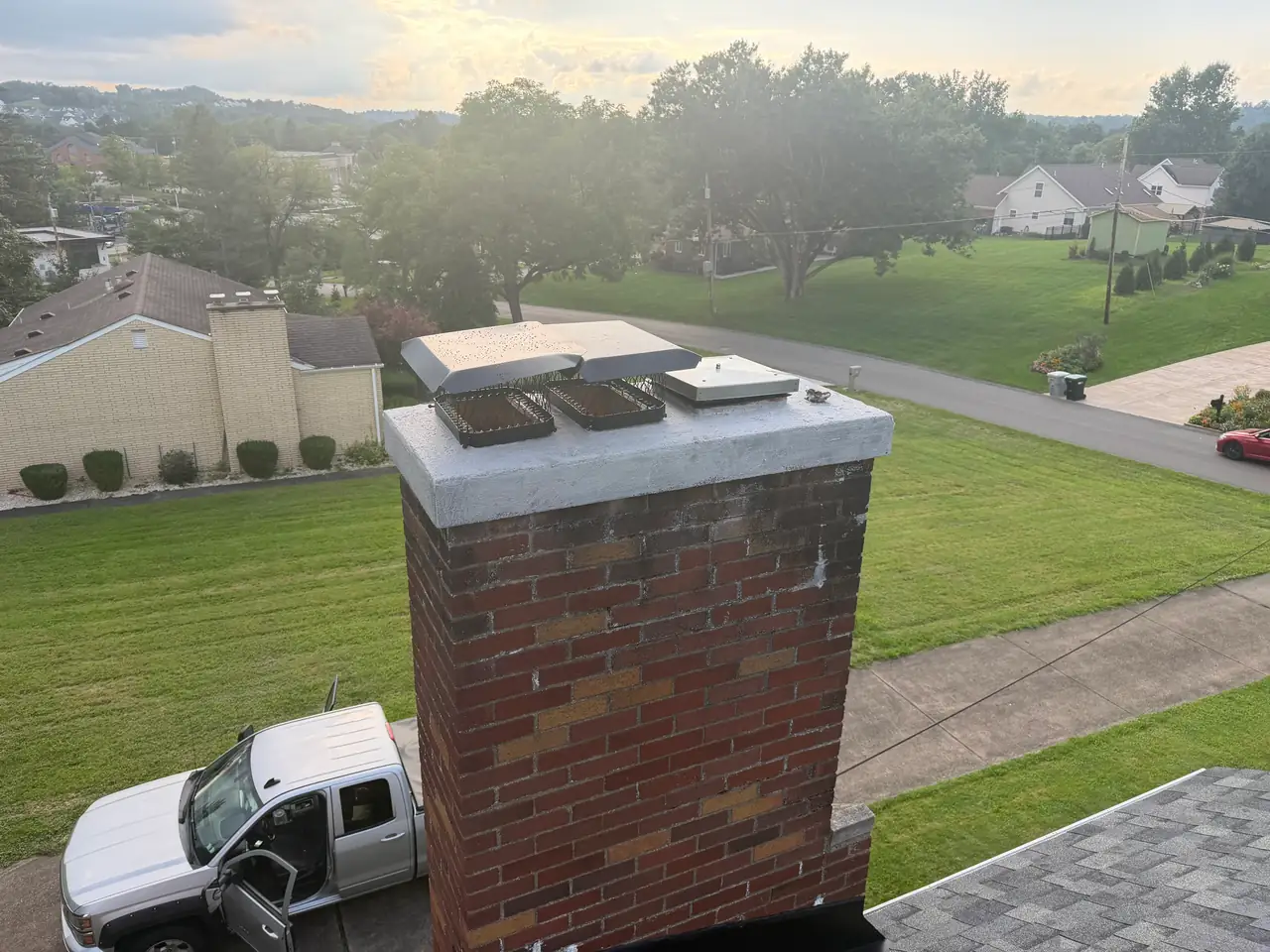
Look at the before shot. Three clay tiles standing wide open to the sky, not a cap on any of them. The crown around them is weathered gray, cracked down the face, with lichen growing along the edge and a loose chunk of masonry sitting on top. Below the crown the brick has heavy white staining on it. That is efflorescence, salt pulled out of the masonry by water moving through it, and it means water had been getting into this chimney for years before anyone called me.
The sweep came first
The flues got swept before anything went on top of them. That order matters and it is the step people skip. Once you cap a flue and seal a crown you have closed the chimney up, and if there was buildup or a nest sitting in there you have just sealed it in. Sweeping first also means I have actually seen the inside of the flue before I tell you the rest of the work is worth doing.
Then the open flues got covered
Three uncapped flues is three holes pointing straight down into the house. Every rain that lands on that chimney goes right in and sits there, because a flue has nowhere to drain and no air moving through it to dry it out. That standing water is what rusts a damper, breaks down a clay liner, and keeps the masonry wet from the inside. Two of the flues got new caps. The third and largest got the top-mount damper, which covers it just as well.
Then the crown got coated
The crown is the concrete slab across the top, and its whole job is throwing rain clear of the brick. Once it cracks it does the opposite: it funnels water down into the brickwork underneath. Coating it lays a flexible waterproof layer across the slab that seals those cracks and keeps flexing with the masonry instead of splitting straight back open. Done at this point it is a repair. Left another handful of winters, that same chimney needs the crown torn off and poured new, and probably brick along with it.
Then the top-mount damper went on
A top damper sits at the very top of the flue and closes against a gasket, worked by a cable that runs down to the firebox. Closed, it seals the flue completely, so it keeps rain and animals out the way a cap does and also stops the heat you are paying for from going up the chimney all winter. The old damper down above the firebox on a chimney this age is usually rusted or warped and not closing on anything.
Sealed top, covered flues, swept flues. The water is shut off at the source, which is the only way any of the rest of it holds.
What a Missing Cap Actually Costs You
A cap is the cheapest thing on the chimney, which is exactly why it is the thing people leave off. Here is what an open flue buys you.
Rain goes down the flue and sits. On a clay tile liner that washes out the joints between tiles and cracks the tiles themselves. On anything metal in the system it means rust. Animals get in, because an open flue is a dry vertical shaft and birds and squirrels will nest in it, which is a blockage and a fire risk at the same time. And wind pushes down an open flue, which is where the cold draft and the smell in the room come from.
The chimney in the photos had none of that protection, on three flues at once, for years. I laid out the full case in why chimney caps matter, and the cap options are on my chimney cap installation page.
Crown Coating or Crown Rebuild
I get asked on every crown whether it can be saved. It comes down to whether the slab is still sound as a structure.
If it is solid but cracked, coating is the fix. It bridges the cracks, stays flexible through freeze and thaw, and seals the top before water gets any further down. If the crown is crumbling, cracked all the way through, or was poured flat with no overhang to begin with, a coating will not save it and I will tell you that instead of taking the easier job. That one needs tearing off and pouring a new one with a real slope. I go through both cases with photos in my post on chimney crown repair, coating versus rebuild, and the wider masonry work is on my Pittsburgh chimney repair page.
Why a Top Damper Beats the One in Your Firebox
Most older fireplaces have a throat damper, a cast plate sitting in the masonry just above the firebox. New, it works. After decades of heat and moisture it warps and rusts and stops sealing, and because it sits down inside the chimney it never protected the flue above it from rain to begin with.
A top-mount damper fixes both at once. It mounts at the top and closes on a silicone gasket, so it genuinely seals. Closed, it keeps rain and animals out of the whole flue. Open, you have a normal fireplace, worked by a cable from inside the firebox. Nothing about using it changes.
What I Look For on a Sweep and Inspection
A sweep is not just cleaning. It is the only way to see the parts of a chimney that matter. While I am in there I check the liner down the full length of the flue for cracks and open joints, the smoke chamber above the firebox, the damper, the crown and the flue tiles up top, and the flashing where the chimney passes through the roof.
Then you get told what I found and a written estimate for what the chimney needs, nothing padded on. I would rather you be home so I can show you instead of describing it. The estimate is free either way. If you are buying a house around here and want the chimney checked before closing, I wrote up what a chimney inspection covers when you are buying.
Canonsburg and Washington County
Along with Canonsburg I work North Strabane, Houston, Cecil Township, McMurray and Peters Township, Southpointe, and Meadowlands.
Two different kinds of chimney in the same town
Canonsburg is genuinely split, and it changes what I find when I get on the roof.
The older borough core is brick homes with real masonry chimneys, clay tile flues, and poured concrete crowns, built when that was simply how you built a house. They fail the way the one in the photos did. The crown cracks, the flues sit open because a cap was never anyone's priority, and water works its way down through the masonry over decades. That is masonry work, and the chimney is almost always worth saving.
Out toward Southpointe and North Strabane the housing is much newer, and a lot of it was built with prefab metal fireplaces venting up a framed chase instead of a brick stack. Those are a different animal. There is no crown to coat and no joints to repoint, so the failures move to the chase cover, the flashing, and the factory cap and pipe on top. Same physics, water coming in from above, different parts.
What our winters do to an open flue
Southwestern Pennsylvania spends the winter crossing back and forth over freezing, and that is what turns a small problem into an expensive one. Water gets into a cracked crown, freezes, and expands as it turns to ice, pushing the crack wider. It thaws, more water gets into the bigger opening, and it goes again. An open flue makes it worse than a cracked joint does, because it is not a trickle soaking in. It is every drop of rain that lands on that opening going straight down inside, where it pools and cannot dry. That is why a cap is not a cosmetic upgrade.
If you are closer to the South Hills side of things, I also work Bethel Park and Upper St. Clair, both a short run up from Canonsburg.