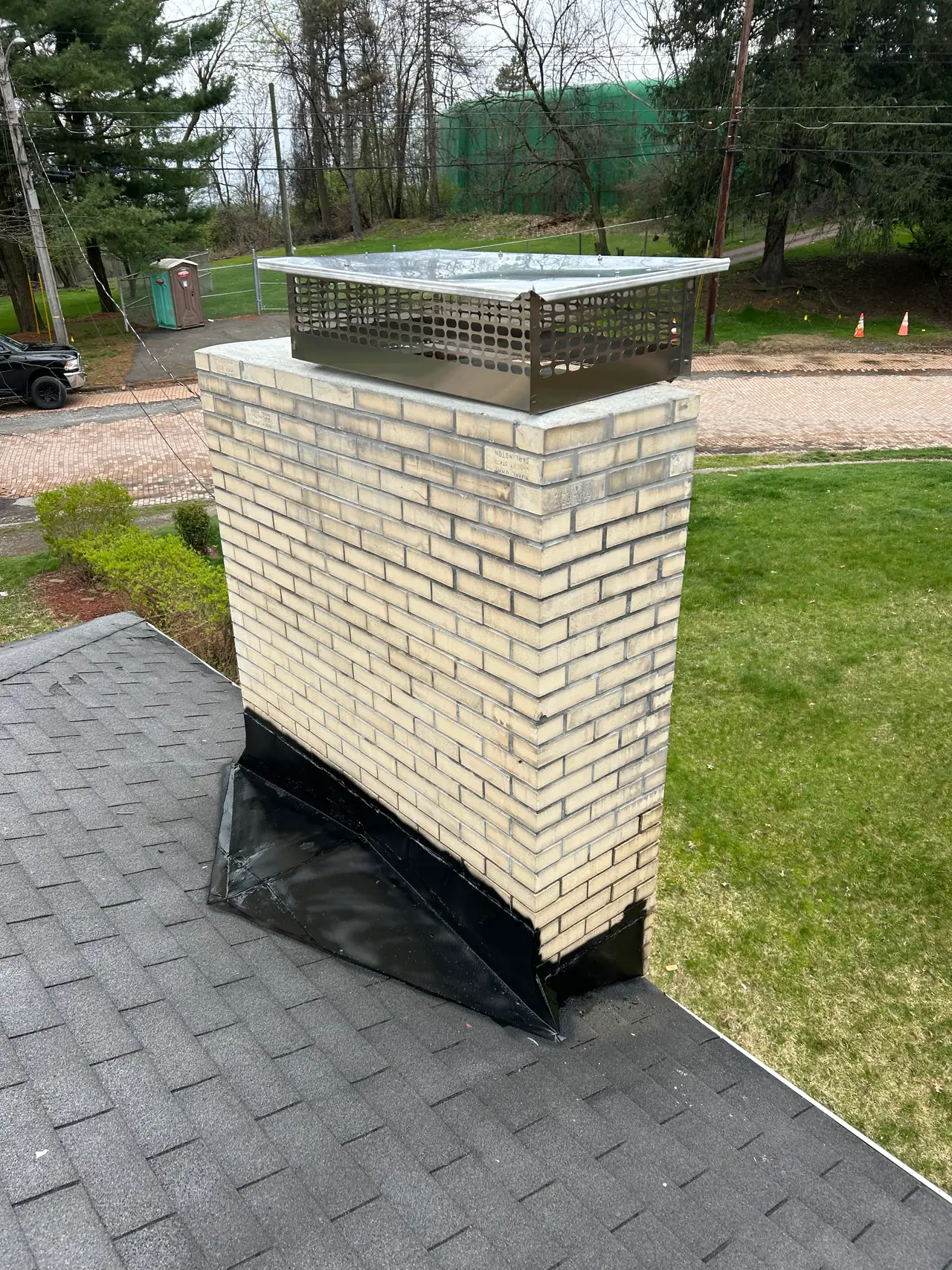
I’m a chimney tech, and I do the cap work myself on homes throughout Verona and along the Allegheny River. The houses down here have some age on them, a lot of them dating to when the borough grew up along the river, and the chimneys show it. Open flues, rusted-out caps, and crumbling crowns are what I find on top. If yours is missing or shot, I’ll size and install the right cap and seal your flue back up. The stainless cap in the photo below is a job I finished in the area.
☎ Call (412) 440-5871 Free Cap Assessment
The Caps I Install in Verona
Stainless Multiflue Caps
A multiflue cap is one large stainless cap that covers the whole top of the chimney and every flue under it at once, like the one in the photo. It bolts to the brick on the outside, throws water off the crown, and because it is heavy-gauge stainless it carries a lifetime warranty. On the wider chimneys common in the older Verona housing stock, it is usually the cleanest, longest-lasting fix.
Single-Flue Caps
If your chimney has just one flue, or you want each flue capped on its own, a single-flue cap mounts right to the tile. It is the budget-friendly option, and I still set it in stainless so it holds up to the damp coming off the river.
Custom Fabrication
Plenty of the chimneys down here are odd sizes that no stock cap fits. When that is the case I build a custom cap to your flue’s real measurements so it seats properly instead of leaving gaps.
Why Stainless, Not Galvanized
I do not put galvanized caps on Verona chimneys. Between the humidity off the river and our freeze-thaw winters, galvanized rusts through and streaks the brick fast. Stainless is what lasts down here.
Sizing and Securing the Cap Right
A cap is only as good as its fit. My process on every Verona job:
- I measure the flue, or the full crown, to get the right cap size and style.
- I check the masonry up top to be sure there is a sound surface to anchor to, since the older crowns here are often soft.
- I fasten the cap with proper hardware and sealant so it sits tight and weatherproof.
- I make sure the draft is still clear before I leave.
On these river-valley chimneys the crown is often the weak point, so part of securing a cap is making sure what I am bolting to will actually hold. A cap mounted to crumbling masonry will not stay up there, which is why I check it first.
Signs Your Verona Chimney Needs a Cap
- A flue opening sitting bare and open at the top, or a cap that is clearly rusted or knocked loose.
- Rust streaks bleeding down the brick face.
- Animals nesting in the chimney, or scratching and noises in the flue.
- A musty, damp smell from the fireplace, or staining on the wall around the chimney.
- Smoke or cold drafts blowing back down into the room on windy days.
What the River Valley Does to an Uncapped Flue
Verona sits right down in the Allegheny River valley, and that means damp. An uncapped flue takes in rain and snowmelt straight down the pipe, and between the river humidity and our hard freeze-thaw winters that water never really gets a chance to dry out. It soaks into the masonry, freezes, and breaks the chimney down from the inside. The liner takes the worst of it. A clay tile liner that stays wet cracks and falls apart over a few winters, and once it is cracked it is not safe to vent through. A missing cap is one of the top reasons I wind up relining a chimney here, and where the same flue serves a furnace or water heater, that is how an orphaned water heater or an old oil-to-gas setup ends up with a damaged liner. For the full picture on what a cap protects, I laid it out in why a chimney cap matters.
Verona and the River Towns
I cap chimneys throughout Verona and the neighboring river communities, from the older frame and brick homes up off Allegheny River Boulevard to Oakmont across the Hulton Bridge, and over into Penn Hills, Plum, Blawnox, and Aspinwall. If you are east in nearby Monroeville, I handle caps there too. This is the kind of older, tightly built housing stock where a good cap matters most, because the masonry underneath has already put in a hundred years. Give me a call and I will come take a look.