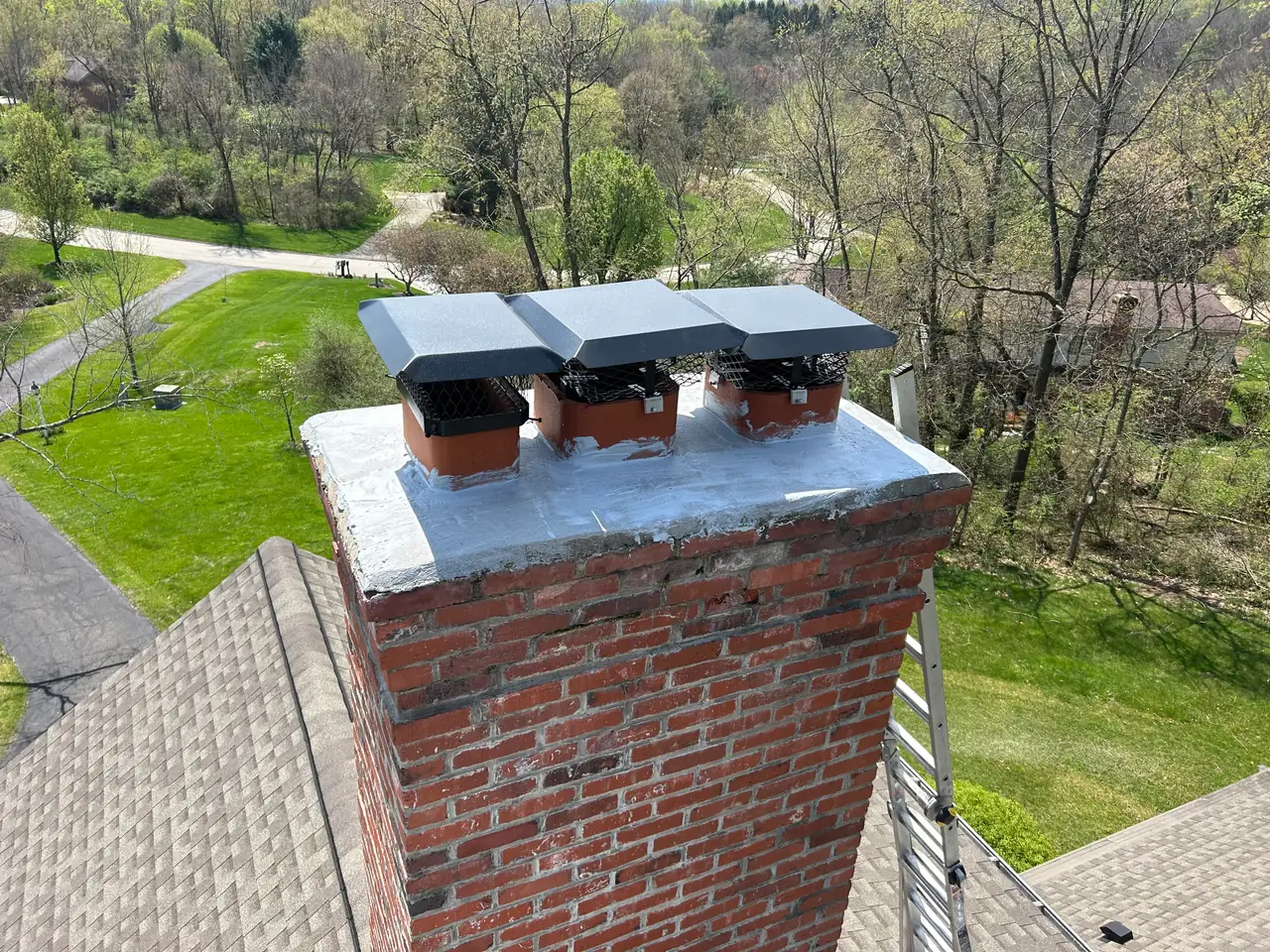
I’m a chimney tech, and I install the caps myself, up on the roof, on homes all over Monroeville. A lot of the chimneys I climb out here went up when the post-war neighborhoods off William Penn Highway and Northern Pike were built, and plenty of them have two or three open flues sitting up top with nothing covering them. If your cap rusted out, blew off in a storm, or was never there in the first place, I’ll get up there, size the right cap, and lock your flue back up. The three black caps in the photo below are from a Monroeville job I just finished.
☎ Call (412) 440-5871 Free Cap Assessment
The Caps I Install in Monroeville
Single-Flue Caps
A single-flue cap covers one flue tile and mounts straight to it. On a chimney with separate flues, like the one in the photo, I cap each tile on its own. It’s the straightforward, affordable fix for most Monroeville chimneys, and I use stainless steel so it does not rust out the way the cheap galvanized caps do after a few of our winters.
Multiflue and Full-Coverage Caps
When a chimney has several flues bunched close together, or a crown that has seen better days, one large multiflue cap that bolts to the brick and covers the whole top is often the better call. It shields every flue and the crown itself at once, and the heavy-gauge stainless version carries a lifetime warranty.
Custom Caps
Some of the older or oversized chimneys around here do not take an off-the-shelf size. For those I fabricate a custom cap to the actual dimensions of your flue or crown, so the fit is tight instead of forced.
Stainless, Not the Cheap Stuff
I put stainless steel on Monroeville chimneys because our weather eats galvanized caps alive. Stainless stands up to the rain, snow, and freeze-thaw without rusting through or streaking the brick, and it is the last cap most of these flues will ever need.
How I Size and Secure a Cap
A cap only does its job if it fits and it stays put. Here is how I work:
- I measure each flue, or the whole crown, to get the exact size and style your chimney needs.
- I check the crown and the masonry I am mounting to, so there is a solid surface to fasten against.
- I set the cap with the right hardware and sealant for a tight, weather-proof fit that will not lift in the wind.
- I confirm the cap is not choking the draft before I pack up.
A cap that is the wrong size or mounted loose causes draft trouble or comes off in the next storm, and up on the exposed ridgelines around Monroeville the wind gets a good run at it. Getting the fit right is the whole job.
Signs Your Monroeville Home Needs a Cap
- Rust streaks running down the brick, or a cap you can see is rusted, tilted, or gone.
- Birds or squirrels coming and going from the top of the chimney.
- Water stains on the ceiling near the chimney, or a damp, musty smell from the firebox.
- Downdrafts pushing smoke or cold air back into the room.
- Pieces of an old cap turning up in the yard or gutter after a windstorm.
Why an Uncapped Flue Fails Faster Here
An open flue is a straight pipe for rain and snowmelt down into your chimney, and our climate makes that worse than it sounds. The water soaks the masonry, then our freeze-thaw winters freeze it, expand it, and crack the chimney apart from the inside, one cold night at a time. The part it ruins fastest is the liner. A clay tile liner that stays wet through freeze after freeze cracks and breaks down, and a cracked liner is not safe to run a furnace or a fire through. A missing cap is one of the most common reasons I end up relining a chimney, and in a lot of these homes the same open flue also vents the furnace or water heater, which is how an oil-to-gas conversion or an orphaned water heater ends up with liner trouble. If you want the full background on what a cap does and why it matters here, I wrote it up in why a chimney cap matters.
Monroeville and the Surrounding Area
I install caps across Monroeville and the eastern suburbs, from the brick ranches and split-levels around Garden City and Forest Hills Road to the larger homes out toward Murrysville, and over into Pitcairn, Wilkins Township, Turtle Creek, and the east end of Penn Hills. If you are in nearby Verona, I cover that too. Most of this is the post-war housing stock that fills Monroeville, where the chimney has been standing a lot longer than anyone has looked at what is on top of it. Call me and I will get up there.