If the shaded side of your roof has gone green, or dark clumps are building up along the shingle edges, that is moss, and on an O’Hara roof it does not dry out and clear off on its own. I am Tom, and I am the one who climbs up and does the work. I spend my weeks on roofs right here in O’Hara Township doing chimney work, so I already know how these wooded, shaded lots hold moisture and feed growth on the shingles. Cleaning the roof the safe way is part of the same job I am up there doing anyway. Here is what I see on O’Hara roofs, why the moss takes hold so fast, and how I clear it without wrecking the shingles.
☎ Call (412) 440-5871 Free Roof Assessment
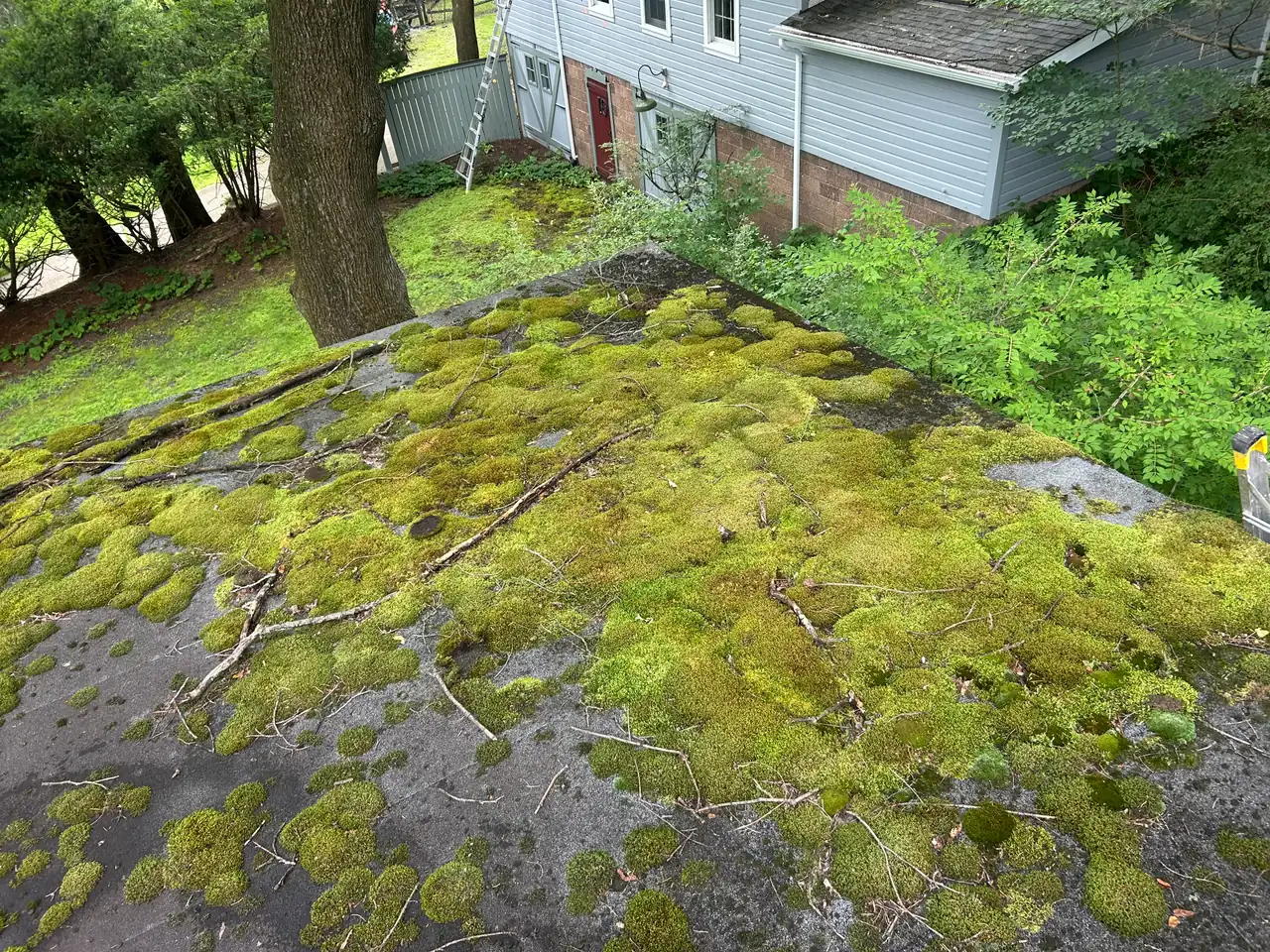
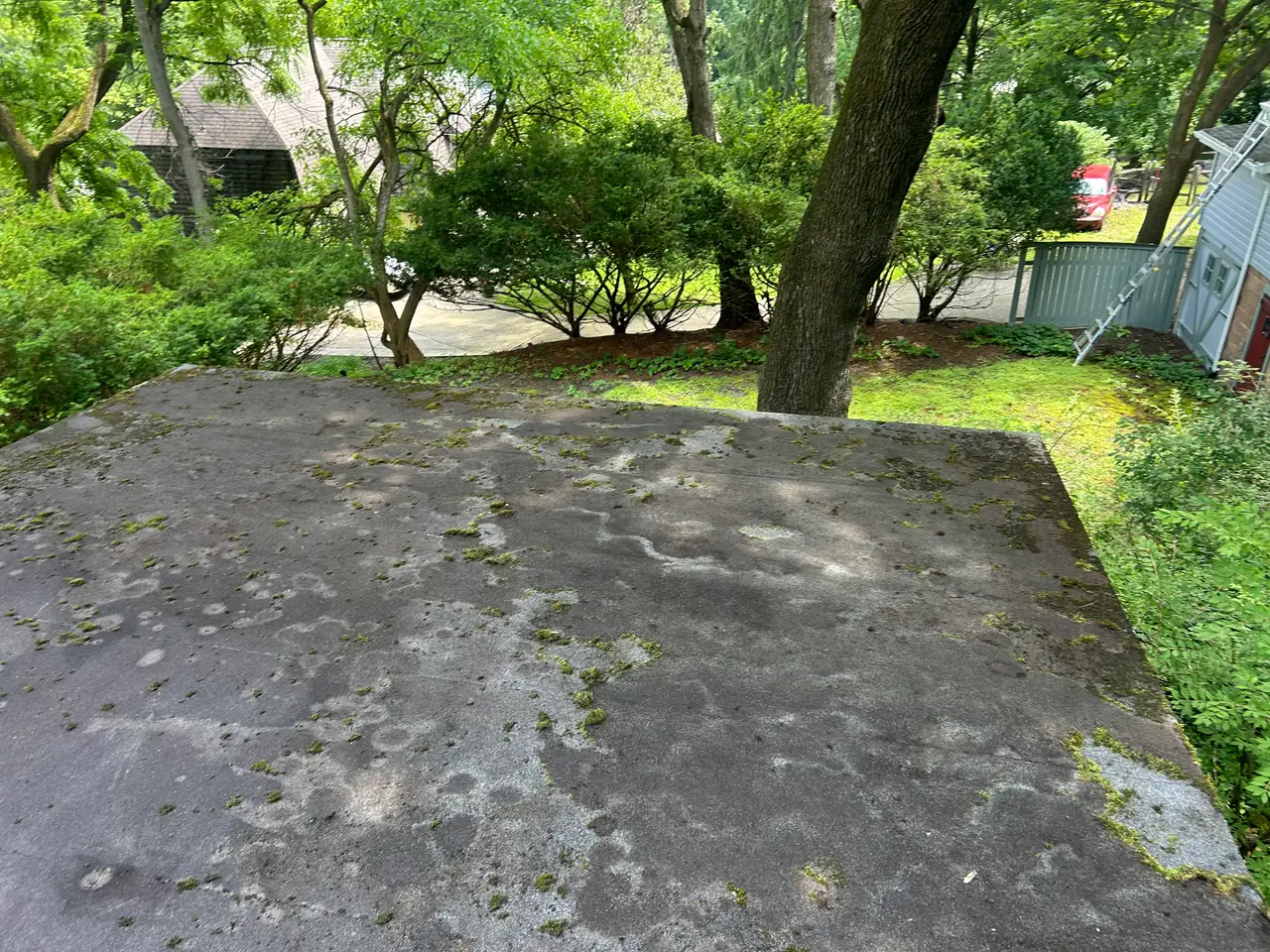
An O’Hara Roof I Just Cleaned
The photos here are from a recent O’Hara job on a shaded, tree-covered lot. The roof had gone almost solid green, with moss mounded across the whole slope and fallen branches buried in it. I treated it with a soft wash, cleared the dead moss and debris off by hand, and cleaned out the valleys. The after shot is the same roof with the moss gone and the shingle surface open to the air again instead of sitting under a wet green blanket.
Why O’Hara Roofs Grow Moss Faster
O’Hara sits in the wooded northeast corridor next to Fox Chapel, and that setting is everything moss wants. These are large lots under heavy, mature tree cover, and the canopy throws shade over the roof for most of the day. A roof that rarely gets a few hours of direct sun stays damp, and steady damp is the first thing moss needs to dig in.
Constant shade and tree debris
The oaks, maples, and pines over these lots drop leaves and needles onto the shingles all season, and that debris settles into a wet mat that traps moisture right against the roof. Every limb hanging over the roof is doing two things at once: throwing shade that keeps the surface wet, and dropping fresh spores onto the shingles. That is why the roofs I see here go green so much faster than a roof sitting in an open, sunny yard.
River-valley humidity
O’Hara runs down toward the Allegheny River, and the valley holds humidity. The air near the river stays heavy and slow to dry, so the north-facing slopes, the ones that already get the least sun, never fully dry out between rains. That is where I find the moss started first, thick along the shaded eave and packed into the valleys, while the sunny side of the same roof can still look fine.
Older shingles that hold water
Plenty of O’Hara homes have been here a while, and their asphalt shingles have aged along with them. As a shingle gets older it sheds its protective granules and the surface turns rough and porous, so it grabs and holds water instead of shedding it. Moss sinks its roots into that worn surface, and as the clumps swell with water they pry the shingle edges up. Left long enough, that is how a green stain turns into lifted shingles and an open path for water underneath.
Because I am already on O’Hara roofs for chimney work, I see all of this up close, the flashing, the shingle condition, and exactly where the moss is starting. That is not something a national roof-cleaning outfit driving in for the day can tell you about your roof. It is the same roof-and-safety mindset I bring to a chimney inspection, just pointed at the moss instead of the flue.
Signs It Is Time to Clean Your Roof
You can usually catch this from the ground or a second-floor window. Watch for:
- Green moss clumps building up along the shingle edges and in the valleys
- Dark green or black streaks running down the shaded slope
- Patchy dark staining on the north-facing side while the sunny side still looks clean
- Leaves, needles, and branch debris collecting in the valleys and not washing off
- Moss thick enough that you can see it curling or lifting the shingle edges
Any one of these means the growth already has a foothold. The sooner I treat it, the less chance it has to work its way under the shingles and turn into a leak.
How I Clean an O’Hara Roof Safely
I clean the roof in a way that goes after the cause and does not chew up the shingles doing it. The one thing I never do, and you should never let anyone do to your roof, is pressure wash it.
1. Low-pressure soft wash
I treat the roof with a low-pressure soft wash and a roof-safe solution that kills the moss and the algae down at the root, not just the green you can see on the surface. High pressure has no place on a roof. It strips the granules off asphalt shingles, drives water up underneath them, and voids most shingle manufacturer warranties. A soft wash cleans the roof at a pressure that leaves the shingles in one piece.
2. Hand removal of the moss
Once the treatment has killed it, I clear the dead moss and debris off the roof by hand and pull it out of the valleys. Killing the moss and leaving it up there is only half the job, because dead moss still soaks up water and holds it against the shingles the same as living moss. I get it off the roof for real so it stops trapping moisture.
3. Cutting back the canopy
On O’Hara lots the tree cover is usually the whole reason the moss came back the last time, so I cut back the limbs hanging over the roof where I safely can. Pulling the canopy off the roof lets it dry between rains and cuts down the spores raining onto the shingles, and that is what keeps it clean far longer than a spray alone.
4. Clearing the gutters
A moss cleaning knocks a lot of loose material down into the gutters, so I clear them out on the same visit. Backed-up gutters push water under the shingle edges and rot the fascia, which would quietly undo the roof work, so clean drainage is part of finishing the job right.
I am owner-operated, so when you call, you get me on the roof, not a crew sent out behind a salesman. Since I am often already up top for a chimney sweep or an inspection on these homes, adding a roof cleaning to the same trip is easy, and it pairs directly with my roof moss removal service. I will tell you straight whether your roof needs a full cleaning or just a treatment, and I will not push work it does not need.
Roof Cleaning Across O’Hara Township and Nearby
O’Hara Township is right in the wooded northeast stretch where I do most of my work. I clean roofs across O’Hara and the tree-covered suburbs around it, Fox Chapel, Aspinwall, Blawnox, Sharpsburg, and the rest of the Allegheny Valley, plus the wider Pittsburgh area. If your roof sits in shade, tucked under trees, or just has not been cleaned in years, that is the kind of roof I work on constantly. Give me a call and I will come take a look.