Gutters are the cheapest part of a house to maintain and one of the most expensive to ignore. A packed gutter does not look like much from the driveway. What it does is send a whole roof's worth of rainwater over the lip, down the fascia, and along the foundation wall, and that bill shows up years later in the basement.
My name is Tom and I own The Chimney Experts INC. Gutter cleaning is a natural part of what we do, because my team and I are on Pittsburgh roofs every week for chimney work. Same ladders, same roofs, same houses. Below is what we actually do on a gutter cleaning visit, why gutters fill up and fail harder here than people expect, and when to get it on the calendar.
☎ Call (412) 440-5871 Get a Gutter Cleaning Quote
What a Gutter Cleaning Visit Includes
A gutter cleaning is not a leaf-blower pass from the top of a ladder. Blowing a gutter out moves the dry material sitting on top and leaves the wet sludge packed in the bottom, which is the part that actually holds water and blocks the outlet. Here is the order we work in.
1. Clearing the Gutters by Hand
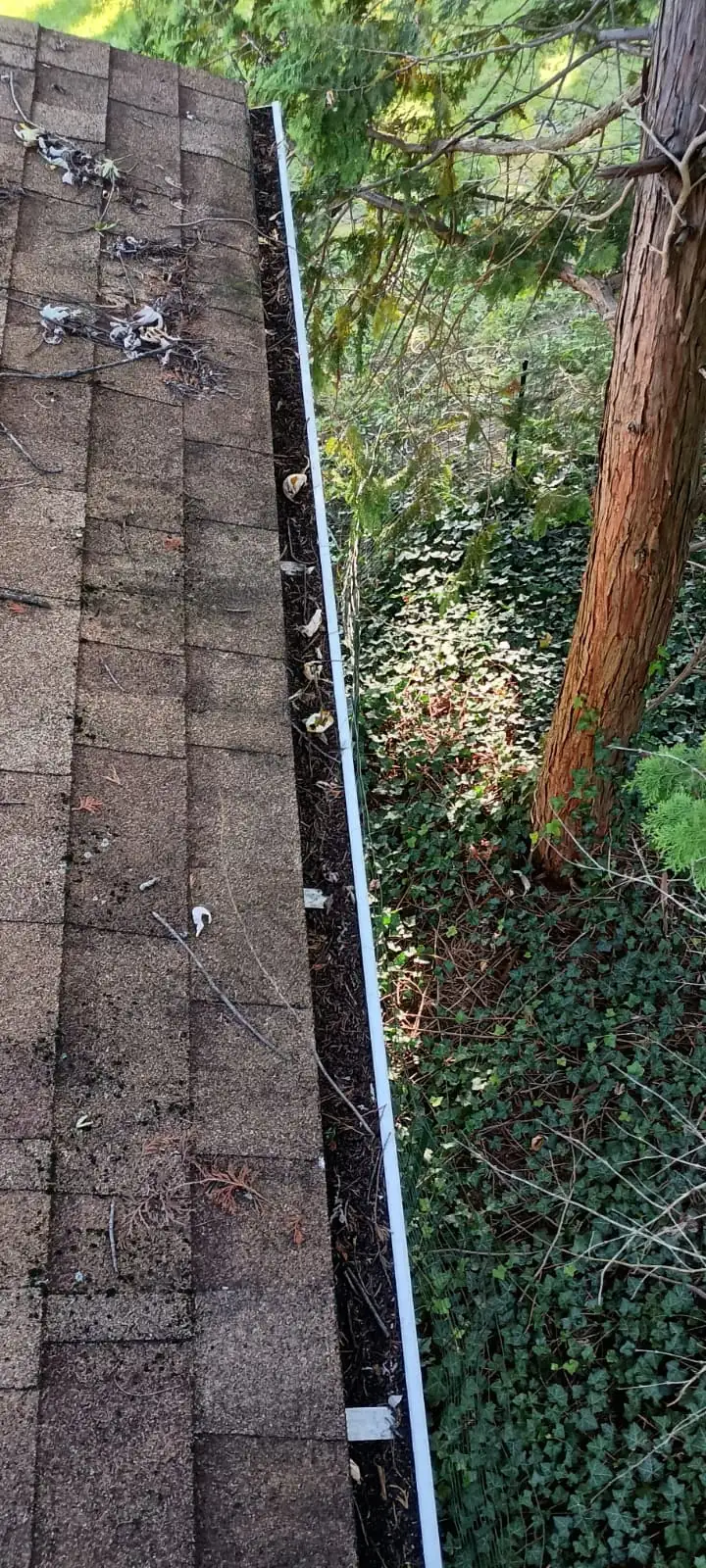
We work the full run by hand, pulling out the leaves, the needles, the shingle grit, and the compacted muck in the bottom of the trough. That bottom layer is the one that matters. It is what keeps a gutter holding standing water after the rain has stopped, and standing water is what rusts a steel gutter from the inside and rots the wood behind it.
2. Flushing the Downspouts
A clean gutter that drains into a blocked downspout is still a broken gutter. Downspout cleaning is its own step: we check that every outlet is actually open, clear the blockage if one is packed at an elbow, and flush the line with water to confirm it runs out the bottom. If a downspout is plugged somewhere we cannot reach from the top or the bottom, we tell you where it is and what it will take, instead of leaving you to find out in the next storm.
3. Bagging and Hauling the Debris
What comes out of the gutter leaves with us. It does not go in your flower beds, it does not get raked onto the lawn for you to deal with, and it does not sit in a pile by the garage.
4. Checking the Hangers, Seams, and Pitch
While the gutter is open and empty, we look at the part nobody ever sees: whether the hangers or spikes are still holding, whether the seams and end caps are leaking, and whether the run still pitches toward the downspout or has sagged into a low spot in the middle. A gutter full of debris hides all of that. An empty one shows it.
5. Photos of What We Found
You get photos. Before and after on the gutters, plus close-ups of anything we flagged, like a pulled hanger or a split seam. You should not have to take a contractor's word for what is going on 25 feet above your head.
6. A Look at the Chimney While We Are Up There
This is the part that comes with hiring a chimney company to do your gutters. We are already at the roof, so we look at the chimney crown, the cap, and the flashing where the chimney meets the roof, and tell you if something needs attention. No charge and no pressure, just a look from someone who does that work for a living. More on that below.
Why Gutter Cleaning Matters on a Pittsburgh House
Gutters fill up everywhere. There are four things about houses here that turn a full gutter into actual damage faster than it would somewhere flatter, drier, and newer.
The Tree Cover and the Fall Leaf Load
A lot of the streets we work sit under mature oaks and maples that have been there longer than the houses have. Squirrel Hill, Regent Square, Forest Hills, the older parts of Mt. Lebanon, the wooded lots up through Fox Chapel and O'Hara Township. On a lot like that the gutters do not collect a light dusting of leaves in October. They take the whole canopy over about three weeks, and once that mat gets rained on it packs down into a dense wet layer that is not going anywhere on its own. Houses with no trees of their own still get it, because the maple two yards over does not care about property lines.
Evergreens are the other half of it, and they are the half people forget. A cedar, a spruce, or a row of hemlocks along the property line does not dump everything in three weeks and then stop. It drops needles steadily all year, and needles are worse than leaves once they are in the trough. They knit together into a dense mat, they work their way down into the outlet and pack it, and they break down into the dark sludge in the bottom of the gutter that no amount of blowing will move. A house under conifers can have a gutter clogged solid in July.
Freeze-Thaw Winters Turn a Clog Into Ice
This is the one that does real damage. A clogged gutter does not drain, so it holds water. When the temperature crosses freezing, that water turns to ice and expands, and it does that again every time the temperature crosses back and forth, which it does repeatedly here from late fall into early spring. The ice pushes seams apart, works hangers out of the fascia, and loads a full run with far more weight than it was built to carry. Meanwhile the ice sitting in the trough leaves the next melt nowhere to go except backward, under the shingle edges and into the roof deck.
A gutter cleaned in November is a gutter that drains all winter. The same gutter left packed is the one that comes off the house in February, and it usually takes a strip of fascia with it.
Hillside Lots Send the Overflow Right at Your Foundation
Half of this region is built on a hill. When a gutter overflows on a flat lot, the water at least has somewhere to spread out. On a steep lot, or a house cut into a slope with the grade running back toward the wall, every gallon that comes over the lip lands in the worst possible place and then follows gravity straight down against the foundation. That is how you end up with a damp basement wall, white efflorescence on the block, and water in the corner of a finished basement that has nothing to do with the roof. Working gutters and open downspouts are the cheapest foundation protection on the house.
Older Gutters, and Houses With Built-In Box Gutters
A good share of the housing stock around here is old enough that the gutters have been replaced once already and are due again. Hangers back out of soft fascia wood, seams in sectional aluminum open up, and runs sag into a low spot that holds water permanently. We find all of that while the gutter is empty, and we tell you what we see.
Some of the older homes in the city have built-in gutters, sometimes called box gutters, that are framed into the roof edge and lined rather than hung off the fascia. Those are a different animal from a hung gutter and they are unforgiving when they back up, because there is no outside edge for the water to spill over harmlessly. If that is what your house has, say so when you call so we come out knowing it.
Clogged Gutters and Roof Moss Feed Each Other
These two problems are really one problem. A gutter packed with wet debris keeps the bottom foot of the roof damp long after the rain has stopped, and a shaded roof edge that never dries out is exactly where moss takes hold first. Then the moss sheds back into the gutter and packs it tighter, along with the shingle granules it pulls loose. Round and round.
So if your gutters are full and the bottom edge of your roof is going green, clearing the gutters is half the job. The other half is on our Pittsburgh roof cleaning page, and the growth itself is covered under roof moss removal. It often makes sense to do both on one visit, since we are up there either way.
We Are Already on the Roof, So the Chimney Gets a Look
Most gutter outfits are ladder outfits. We are a chimney company, which means the trip up is something we make every day and the chimney is something we actually understand. While we are clearing your gutters we look at the crown, the cap, and the flashing, and we tell you what we see.
That overlap matters more than you would think, because water going where it should not is the common thread. If you have a stain on the ceiling near the fireplace, that is chimney leak repair territory and the source is usually the crown, the cap, or the flashing. If the masonry itself is coming apart, that is chimney repair. And if you burn wood and it has been a while, that is a chimney cleaning, which is the work this company was built on. One visit, one trip up.
When to Schedule
Twice a year on a treed lot, once a year if you are out in the open. The two windows that matter:
Late fall, after the leaves are down
This is the important one. You want them cleared after the trees have finished dropping and before the hard freezes set in, so the gutters go into winter empty and draining. Book it early if you can. Late fall is when everybody calls at once, and the weather closes that window on its own schedule, not ours.
Spring, after the thaw
Spring is cleanup and inspection. Winter leaves behind whatever blew in after the fall cleaning, plus seed pods, maple spinners, and the shingle grit that works loose over a cold season. It is also the right time to find out what the ice did to your hangers and seams, while there is a whole dry summer to deal with it instead of a week before Thanksgiving.
If it has been years and you have no idea what is up there, do not wait for the right season. Call and we will come look at it.
Where We Work
We clean gutters across Pittsburgh and the surrounding suburbs, so if you have been searching for gutter cleaning near me and getting call centers, we are the local option. Inside the city we are regularly in Squirrel Hill, Regent Square, Forest Hills, and the hillside neighborhoods. In the South Hills, Mt. Lebanon, Dormont, Castle Shannon, Upper St. Clair, and Bethel Park. North and east, Fox Chapel, O'Hara Township, Allison Park, Ross Township, McCandless, Penn Hills, and Monroeville. That covers a good part of Allegheny County, and we work out past it into Westmoreland, Butler, and Washington County as well. The full list of areas we cover is here.
What It Costs
You get one flat quote for the whole job, and you get it before we start. Not an hourly rate, and not a per-foot number that grows once we are on the ladder.
I am not going to put a figure on this page, because the honest range is too wide to be worth anything to you. The length of the run, the number of stories, the pitch of the roof, how reachable the back of the house is on a hillside lot, and how long it has been since anyone touched them all change the work substantially. Two houses on the same street can be a different job. Tell me the address and roughly what you have when you call, and you get a real number for your house with no obligation to use it.