I get called out for ceiling stains a lot. When the stain sits a little off to the side of the chimney instead of right at it, I already have a good idea what I am going to find when I get up there. Flashing.
It is the part of the chimney nobody thinks about, because you cannot see it from the ground and it is not really the chimney and not really the roof. It sits in between. That is exactly why it gets neglected, and why it is the single most common leak point I deal with.
What Flashing Is and Why It Matters
Your chimney comes up through the roof. That means there is a gap running all the way around it where two completely different materials meet, brick and shingle, and neither one seals to the other. Left open, that gap is a direct path into your house.
Flashing is what closes it. It is thin metal, formed and layered so that water running down the roof hits it and gets sent back out over the shingles instead of down into the seam.
A proper flashing job is actually two separate pieces working together, and this matters for understanding why it fails.
Step flashing is a series of individual L-shaped pieces of metal. Each one tucks up under a course of shingles and turns up against the side of the chimney. They overlap each other going up the slope, like scales, so water always lands on top of the next piece down.
Counterflashing is the second layer. It is anchored into the chimney itself and hangs down over the top of the step flashing, capping that vertical edge so water cannot get in behind it.
That overlap is the whole design. Water is never asked to be stopped by a seal. It is redirected, layer over layer, so gravity carries it back out. When flashing is done right it works for decades with nothing holding it together but geometry.
When it is done wrong, or when it wears out, sealant becomes the only thing standing between rain and your ceiling. And sealant does not last.
Why Flashing Deteriorates
Nothing about this is mysterious. Flashing fails in a handful of predictable ways, and I see all of them.
The sealant dries out and cracks
Caulk and sealant at the flashing joint have a service life. They are exposed to full sun, driving rain, and a big temperature swing every single day. Over time they get hard, lose their flexibility, shrink back from the edges, and split. Once that seal opens, the joint is open.
Thermal expansion works the metal loose
Metal moves with temperature, and a roof in direct sun goes through a large swing between afternoon and night. Every cycle the flashing expands and contracts against a chimney that is barely moving at all. Do that a few thousand times and fasteners loosen, laps open up, and edges lift. Nobody did anything wrong. It is just what metal does.
Galvanized flashing rusts through
Plenty of older chimneys around here have galvanized steel flashing. The zinc coating protects the steel until it wears off, and then the steel goes. You get rust staining first, then pitting, then actual holes. Once it is perforated it cannot be sealed. It is done.
Tar patches from a previous repair fail
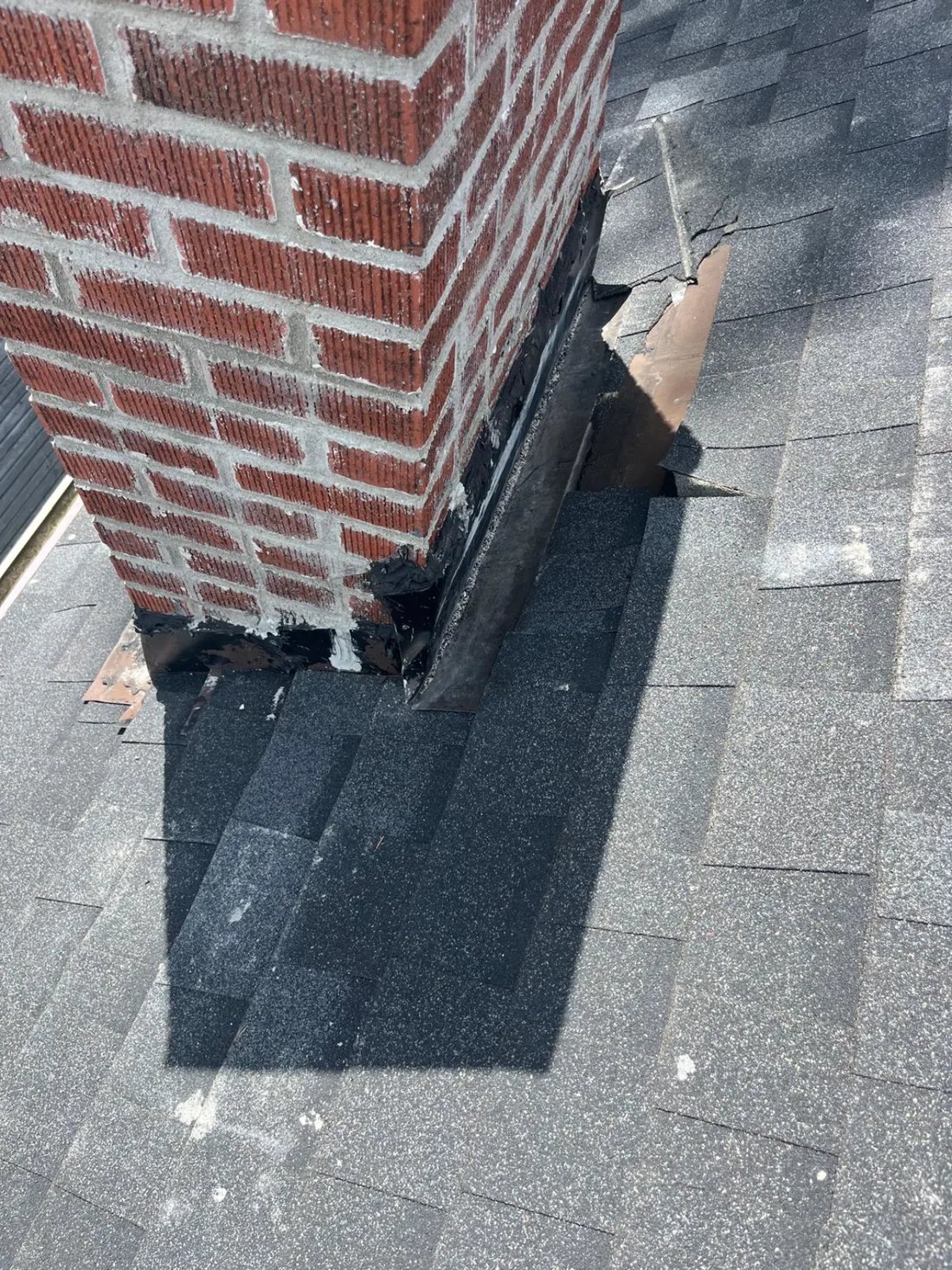
This is the one I find most, and the photo above is a good example of it. Somebody had a leak, and instead of pulling the flashing and doing it properly, they smeared roofing tar over the joint. It works for a while. Then the tar hardens, shrinks, cracks, and separates, and the leak comes back worse, because now water has a channel behind a layer of hard black asphalt that is hiding the damage from view. Tar is a stopgap. It is not a repair.
Step flashing that was never woven in correctly
Sometimes the flashing was wrong from day one. Instead of individual step pieces layered in with each shingle course, somebody ran one long bent piece of metal down the side of the chimney and shingled over it. It looks fine from the roof and it leaks from the first heavy rain, because there is no layered overlap sending water back out. There is just one long seam.
Ice damming and freeze-thaw work the joints loose
This is the Pittsburgh part. Snow on the roof melts from heat escaping the house, runs down, and refreezes where the roof is colder, including around the chimney. Ice builds up and forces water backward, uphill, under the shingles and into the flashing laps where it was never meant to go. Then that trapped water freezes and expands, prying the laps apart a little more. Every time the temperature crosses freezing it happens again. A joint that was watertight in November is working loose by March.
There is nowhere for water to go on the high side
On a lot of chimneys, especially wider ones, the upslope side is a flat shelf. Everything running down the roof hits the back of that chimney and stops. Rain pools there, snow piles up and sits, ice builds in it, and leaves and debris collect and hold moisture against the flashing all year. That side is under constant load the other three sides never see, and it is very often where the flashing lets go first. If a chimney was built without anything up there to move water around it, the flashing on that back side is fighting a losing battle no matter how well it was installed.
What I Can Do About It
There are a few honest repairs here, and which one you need depends on the condition of the metal and on why it failed.
A reseal
If the flashing metal itself is sound, still properly layered, not rusted, not lifted, and the problem is simply that the sealant has dried out and opened up, then I can reseal it. That means cleaning out all the old failed sealant, resetting the counterflashing so it sits tight against the chimney the way it should, and sealing it with a material meant for this that stays flexible instead of going brittle in a season.
This is the cheap version, and it is the right call more often than people expect. Caught early, a reseal buys you years.
A reflash
If the metal is rusted through, if it was installed wrong in the first place, if it is buried under old tar, or if the laps have worked apart, resealing is a waste of your money. That flashing gets removed and replaced.
A proper reflash means new step flashing woven in course by course with the shingles, each piece lapping the one below it, and new counterflashing anchored into the chimney and bent down over the step flashing to cap it. Everything gets sealed at the end, but only as a backup to the layering, never as the thing doing the work.
And if the reason it failed is that water sits behind the chimney with nowhere to drain, new metal by itself will fail the same way. That is when I look at a cricket.
Installing a cricket
Sometimes the flashing is not really the root problem. The problem is that water has nowhere to go.
A cricket is a small peaked structure built onto the roof against the high side of the chimney. It comes to a ridge in the middle and slopes off to both sides, so instead of water hitting the back of the chimney and sitting there, it gets split and carried around both sides and back down the roof. Then it gets flashed in properly and tied into the step flashing running up the sides, so the whole assembly is one continuous layered path.
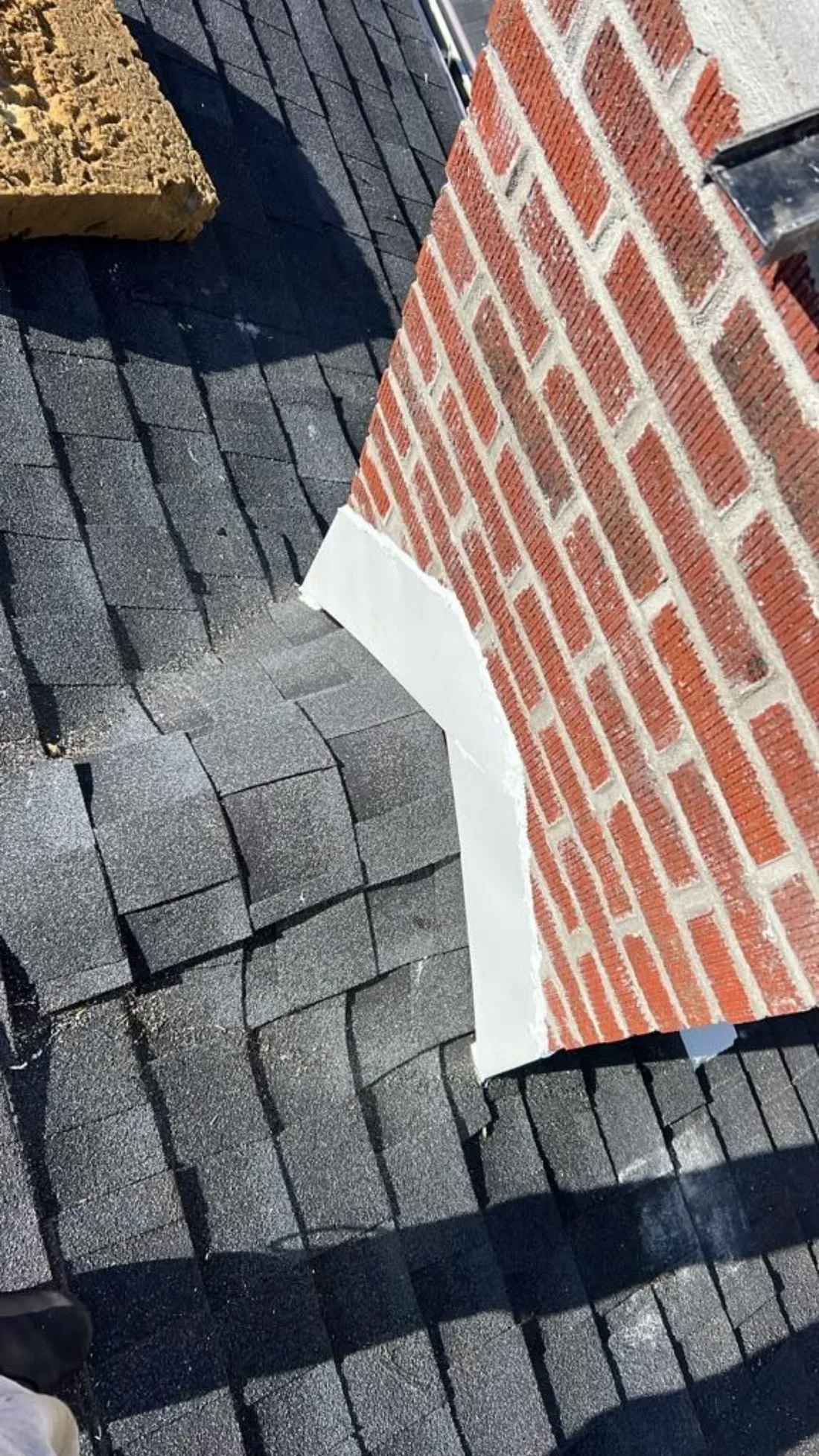
That is what the photos on this page are from. The flashing on that chimney had failed and had been tarred over at some point, so I pulled it and installed a cricket with new flashing rather than putting fresh metal back into a spot that was going to pond water all over again.
This is the repair to ask about if your chimney is on the wider side, or if you have had the same flashing leak come back more than once. If water keeps collecting behind the chimney, new flashing alone is treating the symptom. A cricket fixes the reason it keeps failing there. It is a bigger job than a reseal, and it is the one that actually ends the problem instead of resetting the clock.
Why I will not sell you a tar-only fix as a permanent repair
I want to be straight about this, because it is where homeowners get taken. I can put a bead of sealant or a patch on a bad flashing joint and stop your leak today. Sometimes that is genuinely the right thing to do, if it is January and you have water coming in and the real work has to wait for better weather. I will tell you that is what it is: a stopgap to get you through until it can be done properly.
What I will not do is take your money for a tar smear and call it fixed. It fails in a couple of years, it hides the damage in the meantime, and it makes the real repair harder, because the next person has to clean all of it off before they can do anything. If your flashing needs replacing, I will tell you it needs replacing.
One thing about scope
I work the chimney and the flashing where it meets the roof. If I get up there and find the real problem is out on the roof field, failing shingles, a bad valley, or decking damage past the flashing, I will tell you that plainly and you will want a roofer. I would rather send you to the right trade than sell you a chimney repair that does not stop your leak.
Catch It Early
Here is the honest version of the advice.
By the time there is a brown stain on your ceiling, water has already been getting in for a while. It has been running down framing, sitting in insulation, and soaking sheathing you cannot see. At that point you are not just paying for flashing. You are potentially paying for drywall, paint, and whatever else the water found on the way down.
Flashing that is just starting to go usually gives you warning first:
- Rust staining or pitting on the metal
- Sealant you can see cracked, hardened, or pulled away from the edge
- Counterflashing standing off the chimney instead of sitting tight against it
- A black tar patch, which means somebody already had a problem here
- Laps that have lifted or separated
- Water pooling or debris packed in behind the chimney after a rain
All of that is visible from the roof well before anything shows up inside. That is the difference between a reseal and a reflash plus interior repairs. Same problem, caught at two different points.
If you have had a leak near your chimney, or a roofer patched your flashing a few years back and you have not thought about it since, it is worth having someone actually look at it. I will get up there, take photos, show you what I find, and tell you honestly whether you need a reseal, a reflash, a cricket, or nothing at all right now.
☎ Call (412) 440-5871 Free Estimate
Related reading: chimney leak repair, chimney inspection, and chimney repair.